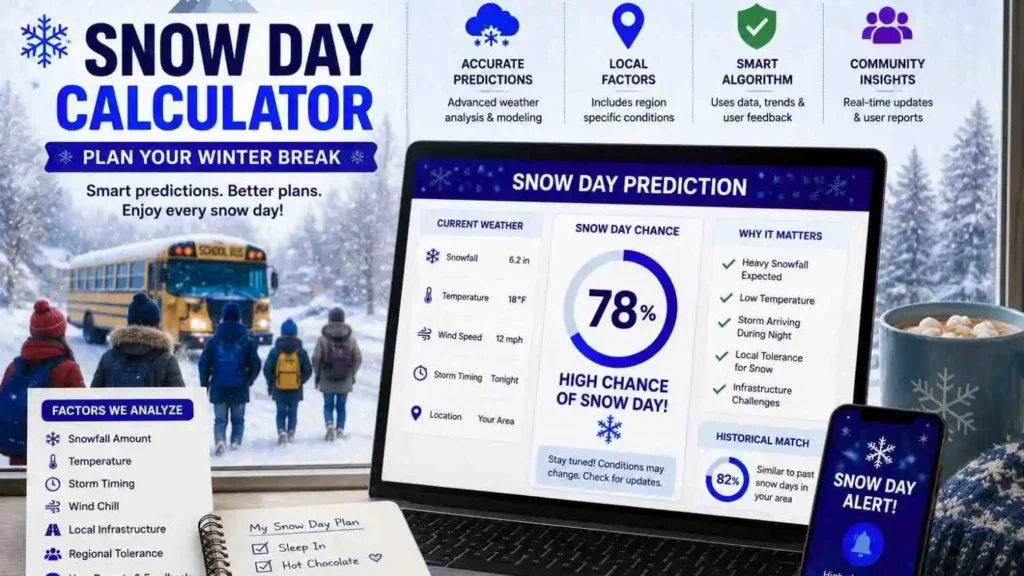
Winter is characterized by a lot of expectancy and thrill, particularly among students who wish to be unexpectedly free from classes. As compared to speculations and gossip, there are numerous individuals who use the modern technology of snow day calculators for making predictions. The intelligent calculator determines the probability of a snow day in a certain region depending on the current weather conditions, including the amount of snow, temperature, and timing of the storms.
These calculators have achieved greater precision due to the involvement of local infrastructure issues, regional tolerance for weather conditions, and even user responses. While their accuracy may not be fully assured all the time, one cannot deny that these calculators offer an interesting way to prepare themselves for any school cancellations that might come their way. Whether you are a student looking to enjoy your first snow day or a parent wanting to plan things ahead, all those interested in learning more about winter trends must continue reading.
Factors That Influence Snow Day Predictions
There are various factors that the snow day prediction tool incorporates in order to come up with accurate predictions. Firstly, there is the volume of the snowfall since heavy snowfall greatly increases the probability of school closures. In addition, even light snowfall can cause disruption in transport. Secondly, the temperature plays an important role since very low temperatures can make the area uninhabitable, irrespective of the amount of snow that has fallen. Thirdly, there is the state of the roads. The conditions of the roads can affect the closure decisions for the schools. This is because icy or unpaved roads can force schools to close. Fourthly, there is the time of the snowfall. There is a higher chance that schools will close after snowing at night than during school hours. Finally, there is the regional policy, where the region may be used to snow.
How to Use a Snow Day Chance Calculator
For one to be able to get the most accurate results from using the snow day calculator, there are some important facts that need to be remembered. One should always make sure that they provide accurate locations by indicating their cities or ZIP codes, since this way, the forecasts would reflect their localities more accurately. It is also very important to make sure that the information on the weather is always up-to-date because, in this way, the forecasts may become more accurate. As the weather conditions tend to change, it is important to consult the calculator several times to see the changes.
Limitations of a Snow Day Estimator
Although the winter closure predictor can be considered an efficient tool for predicting school closure due to heavy snow, there are certain drawbacks associated with its use. It is important to note that the predictor relies on probability rather than certainty in its calculations. This means that more often than not, schools will continue to operate despite the probability of school closures. Its efficiency is dependent on the precision of the information fed into the tool since its calculations are influenced by these parameters. Inaccurate calculations of the information could cause the system to generate erroneous results. Lastly, the decision to close schools rests with the authority concerned.
Conclusion
The Snow Day Calculator is one of the most efficient ways to forecast the closure of schools in wintertime. Based on a combination of weather statistics, historical data, and local facts, it gives you a rough idea at once that might come handy when planning your time. At the same time, you should be aware of the fact that it is nothing more than a helpful tip; you should never base any final conclusions on it. Whether you want to use the tool just for your own entertainment or out of sheer necessity, it brings you closer to snowy days.
FAQ’s
Q1. Is there any chance for a snow day calculator to predict a school closing?
There is no guarantee as such. The final decision is taken by the local authority, keeping in mind the safety of the students.
Q2. Are these calculators applicable in all regions?
These calculators are useful only when the area receives snow on a frequent basis. If the area hardly receives any snow, then the accuracy level will be relatively lower.
Q3. Why does every snow day forecast tool show different results?
The reason being the various formulas, data sources, and weightages used.